Mfg. Education
Here you will find information on manufacturing courses, certificates, and degrees offered in the College of Engineering at UW-Madison.
A manufacturing focus can be applied to any Mechanical Engineering program (ME BS, ME MS Accelerated, ME MS Research, ME PHD, ME Doctoral Minor).
Courses Taught in the Fall Term
- Prof. Michael Biehler
- Techniques and applications of control concepts in the design of inventory, production, quality, and project-planning systems; use of the computer as a component in such systems.
- Prof. Hyunseok Oh
- Newer assistant professor who specializes in rapid alloy development.
- Metallurgy is core knowledge that even ME students interested in metal manufacturing need to have some exposure to.
- Prof. Hantang Qin
- Introduction to the technologies, processes and systems of modern discrete part manufacturing. Emphasis on development of an understanding of the behavior of integrated systems.
- Prof. Lih-Sheng ‘Tom’ Turng
- All major aspects of injection molding with emphases on design, processing, process physics, computer-aided engineering (CAE), troubleshooting, and advanced molding processes. Field trip, video presentation, case studies, term project with oral presentation, and hands-on sessions using commercial CAE simulation software.
- Prof. Sangkee Min
- Learn metal cutting fundamentals and operate state-of-the-art machine tools: 5-axis CNC Mill-Turn Machine and 5-axis Ultra-Precision CNC Mill.
- There will factory tours: usually, one machine tool manufacturer and one cutting tool manufacturer.
- Prof. Mike DeCicco
- This course is a hands-on course that uses real world examples of modeling of solidification and molten metal fluid flow, coupled with melt and molding practice using additive methods for patterns and molds.
- The class makes extensive use of the metal foundry in the Art Lofts at UW-Madison.
- Prof. Kumar Sridharan
- Thermodynamics and kinetics of metallic corrosion. The common forms of corrosion and corrosion susceptibility tests. Electrochemical measurement of corrosion rates. Corrosion prevention, economic considerations. High temperature oxidation and sulphidation. Corrosion case histories.
- Prof. Mike Zinn
- Overview of linear feedback control analysis and design techniques for mechanical systems.
- Prof. Zinn is an applied controls expert with an interest in applying these concepts to manufacturing processes.
- Prof. John Perepezko
- The design, properties, processing and selection of high temperature materials for structural applications. The fundamentals of diffusion, phase transformations, dislocation motion and oxidation governing the high temperature mechanical properties and structural performance of metallic and ceramic materials.
- Prof. Pavana Prabhakar
- Physical properties and mechanical behavior of polymer, metal, ceramic, cementitious, cellulosic and biological composite systems; micro- and macro-mechanics; lamination and strength analyses; static and transient loading; fabrication; recycling; design; analytical-experimental correlation; applications.
- The course will emphasize fabrication of composites more heavily than is alluded to in the course description.
- Prof. Frank Pfefferkorn and Mr. Kevin Klingbeil
- This is the first time this course is being offered.
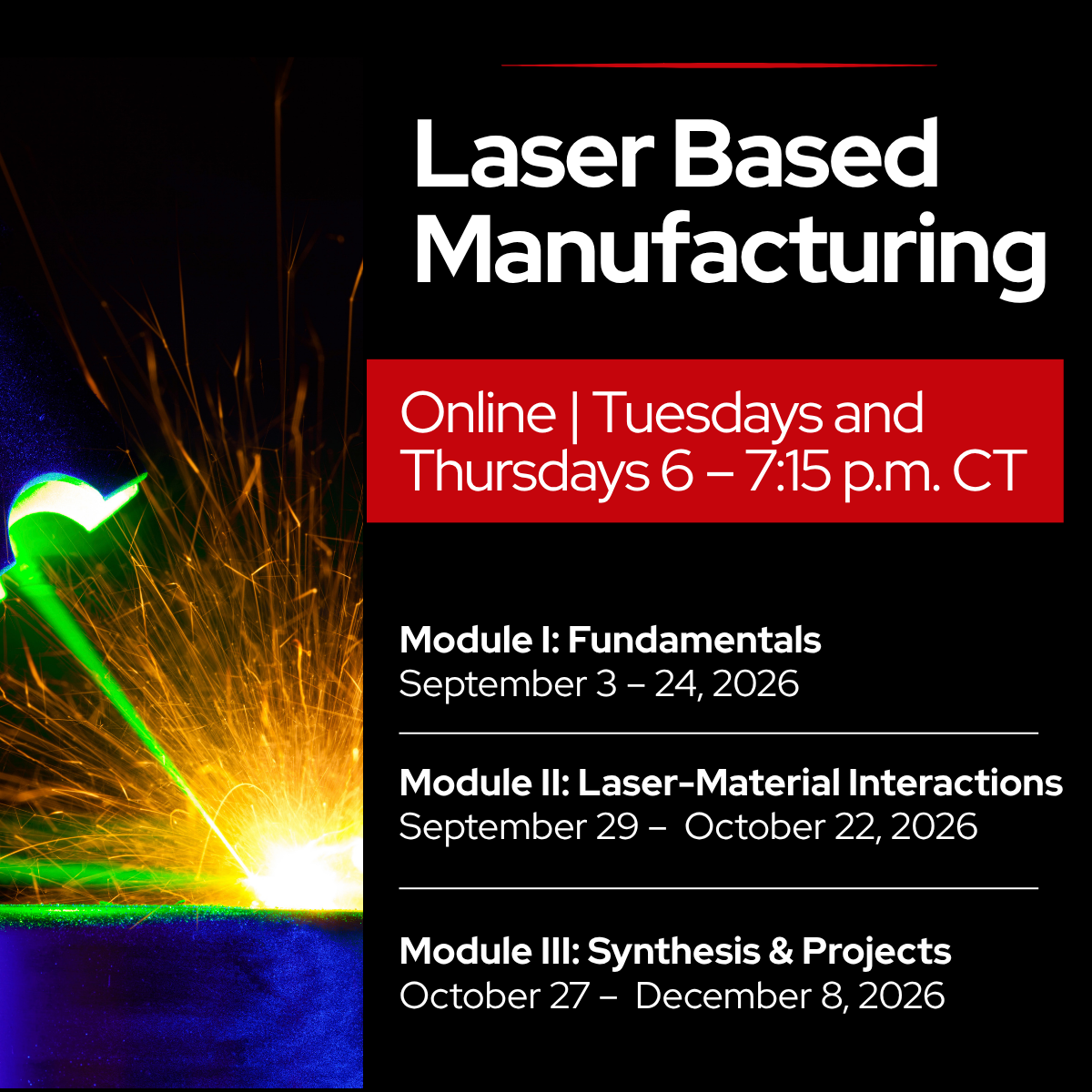
- This course provides a comprehensive introduction to the principles, practices, and applications of laser-based manufacturing, with a focus on the fabrication of discrete metal parts. Students will explore the fundamentals of laser operation, beam delivery optics, and the governing equations of electromagnetic radiation and its interaction with matter. The course blends theoretical concepts with practical knowledge drawn from over 50 years of combined industry and research experience of the instructors.
- See more below under ‘additional options’
- This is a 1-credit course. All other courses in this list, and most courses taught at UW-Madison are 3-credit courses.
- Prof. Michael DeCicco
- The course is exactly what the title says: a guided hands-on instruction where learning comes primarily from taking things apart and learning why parts are designed the way they are and assembled in certain ways.
- Prof. Lianyi Chen
- Prof. Chen is a world-renowned expert in elucidating the fundamental process physics of laser and electron beam powder bed fusion (i.e., metal additive manufacturing using powder feedstock) and identifying solutions to common challenges.
- This course is a deep dive into the laser-material interactions and resulting microstructures and properties of metal additive manufacturing.
Courses Taught in the Spring Term
- ME 401 and ME 964 cover different aspects of metal additive manufacturing, with only a slight overlap.
- Prof. Emily Belknap
- Learn sand casting and plaster investment casting of aluminum and bronze with a focus on individual semester projects.
- Prof. Mike De Cicco
- Prof. Hantang Qin
- Inspection data for quality control; sampling plans for acceptance inspection; charts for process control. Introduction to reliability models and acceptance testing.
- Prof. Hantang Qin
- Addresses the role of the industrial engineer as a “manager” of continuous improvement in design and production processes. Provides modern tools and techniques for planning and managing team projects, integrating the concepts of total quality, data based decision making, and resource management.
- Prof. Kate Fu
- Prof. Christopher Westphal (adjunct)
Notes on Courses:
- ME 529 is designed and only offered to distance learning students in our M.Eng. Manufacturing Systems Engineering program, hence you cannot enroll in this course.
- EMA students please check with your advisor to see how these courses can fit into your program.
- More details can be found in the UW-Madison Course Guide.
- Current students (after logging in with NetID) can find many of the syllabi for technical electives and graduate courses taught by the Department of Mechanical Engineering.
- Current students (after logging in with NetID) can find a tentative course plan for offering technical electives and graduate courses taught by the Department of Mechanical Engineering.
Additional Options
Manufacturing Engineering, Certificate [On-Campus]
This certificate allows undergraduate students to emphasize manufacturing systems or manufacturing processes—or, they can choose to spread courses evenly across both. Students will gain an understanding of these two areas of manufacturing.
Master of Science in Manufacturing Systems Engineering [Online]
Build technical depth in manufacturing systems engineering through a flexible online program. Learn to lead smart, efficient operations through applied learning in process optimization, quality, data-driven decision-making, and automation.
Laser-Based Manufacturing Series [Online]
A three-part series intended for design and manufacturing engineers working with or transitioning to laser based processes.